Dispersed Camping Rules: All 50 States Guide (2026)
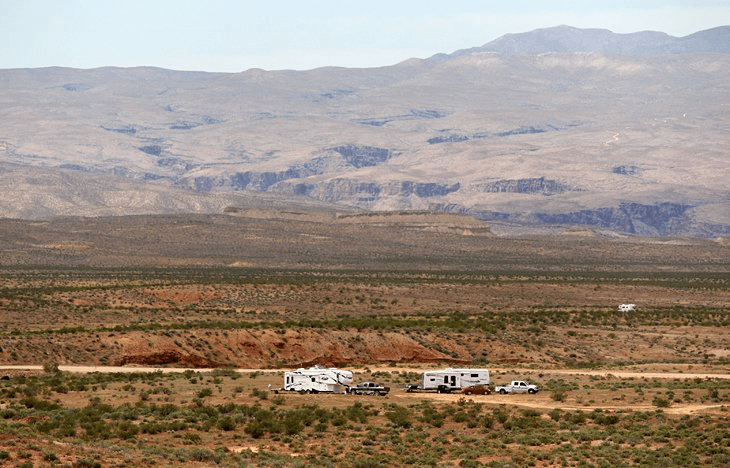
Photo by [PhotoSeek](https://photoseek.com). Licensed for editorial use.
Dispersed Camping Rules on Public Land: State-by-State Guide (2026)
We learned about dispersed camping regulations the hard way. A ranger in northern California pulled up next to our van at 8 AM and informed us we were on day 15 of a 14-day limit and needed to move 25 miles before nightfall. We argued that we'd only been there five days. She showed us the sign at the road entrance that we'd driven past without noticing. The 14-day clock started when we entered the forest, not when we picked our specific spot.
Dispersed camping rules vary not just by state but by which federal land management agency controls the specific parcel of land you're on. A BLM site in Arizona has different rules than a National Forest site in the same state. State trust land has its own regulations. This guide sorts through the confusion and gives you the actual rules that apply to where you want to camp.
What Is Dispersed Camping?
Dispersed camping means camping outside of a designated campground, typically on public land, without amenities like picnic tables, fire rings, or toilets. You pick a spot, you park, you camp. No reservations, no fees, no facilities. Combine free camping with smart planning and you can cut your monthly van life budget by $400–$800 — use our Van Life Cost Calculator to see the difference by state.
The term is sometimes confused with "boondocking," which in the RV and van life communities means the same thing in practice. The Forest Service uses "dispersed camping" as the official term. BLM uses "dispersed camping" or simply "primitive camping." They refer to the same activity.
Dispersed camping is not the same as stealth camping in a city parking lot or pulling over on the side of a highway. Dispersed camping specifically refers to camping on public land where it's permitted under the land management agency's regulations.
Federal Land Rules (BLM & USFS)
The two federal agencies that manage most dispersed camping land in the US have similar but not identical rules.
Bureau of Land Management (BLM) The standard rule on BLM land is a 14-day stay limit within a 28-day period. After 14 consecutive days at one site, you must move. In many BLM jurisdictions, you must move at least 25 miles away before you can start a new 14-day period. Some BLM field offices have different rules for specific areas. Long-Term Visitor Areas (LTVAs) in Arizona allow stays of up to 7 months between September 15 and April 15 for a $180 seasonal fee, which is still remarkably cheap for that duration.
United States Forest Service (USFS) Most National Forests follow the same 14-day limit, but the details vary by forest. Some forests require you to move after 14 days and not return to the same forest for the remainder of the 28-day period. Others allow you to move to a different site within the same forest. The key is to check the specific forest's dispersed camping page or call the ranger station.
Distance requirements are consistent across most National Forests: camp at least 100 to 200 feet from water sources, 100 feet from roads, and on durable surfaces (rock, sand, gravel, or established sites). Motor Vehicle Use Maps show exactly which roads allow dispersed camping along them.
Dispersed Camping Rules on Public Land: What You Need to Know
Calculate how much your route will actually cost
Try the Cost CalculatorFree · Based on 2026 real data · All 50 states
Free · 2026 data · All 50 states
Dispersed camping rules on public land depend primarily on which federal agency manages the land you're on. The Bureau of Land Management (BLM) and the United States Forest Service (USFS) together oversee roughly 435 million acres of public land where dispersed camping is permitted. Understanding these dispersed camping rules on public land is essential before you head out — violations can result in fines of $100-$5,000 depending on the jurisdiction.
The general rule across most public land is a 14-day stay limit within a 28-day period, but the specifics vary significantly between agencies and even between individual field offices. Some BLM districts in Arizona allow dispersed camping with virtually no restrictions beyond the standard time limits, while National Forests in California may require you to obtain a free permit at a trailhead kiosk.
When researching dispersed camping rules on public land for a specific trip, always start with the local field office or ranger station website. Motor Vehicle Use Maps (MVUMs) show exactly which roads and areas allow dispersed camping in each National Forest. BLM field offices maintain similar maps for their jurisdictions. These maps are updated annually and are the authoritative source for what's legal where.
State-by-State Dispersed Camping Regulations
This is where it gets complicated. Each state has its own overlay of regulations on top of the federal rules, and state trust land has different rules than federal land within the same state.
| State | Federal Land Dispersed Camping | State Land | Key Restrictions |
|---|---|---|---|
| Arizona | Allowed, 14 days | Varies by trust | Very permissive on BLM |
| Utah | Allowed, 14 days | Permit required in some areas | Some counties have local bans |
| Colorado | Allowed, 14 days | Permit in some areas | Fire restrictions common |
| California | Allowed with limits | Most state land = no | Strict in SoCal |
| New Mexico | Allowed, 14 days | Varies | Very permissive |
| Oregon | Allowed, 14 days | Some require permit | Fire season closures |
| Washington | Allowed, 14 days | Varies | Seasonal restrictions |
| Idaho | Allowed, 14 days | Some require permit | Generally permissive |
| Wyoming | Allowed, 14 days | Varies | Generally permissive |
| Montana | Allowed, 14 days | Some areas restricted | Bear country rules |
| Nevada | Allowed, 14 days | Varies | Very permissive |
| South Dakota | Allowed, 14 days | Varies | Generally permissive |
| North Dakota | Allowed, 14 days | Limited | Less public land |
| Nebraska | Allowed, 14 days | Limited | Less public land |
| Texas | Allowed on USFS land | Varies | Limited federal land |
| Arkansas | Allowed, 14 days | Varies | Ozark forests permissive |
| Oklahoma | Limited federal land | Varies | Little dispersed camping |
| Minnesota | Allowed in USFS areas | State land = permit | Boundary Waters rules |
| Wisconsin | Allowed in USFS areas | State forest rules | Northern forests permissive |
| Michigan | Allowed in USFS areas | Varies | Upper Peninsula has options |
| North Carolina | Allowed, 14 days | Some areas restricted | Pisgah/Nantahala permissive |
| Tennessee | Allowed, 14 days | Cherokee NF permissive | Smoky Mtn NP = no |
| Virginia | Allowed, 14 days | George Washington NF | Shenandoah = restricted |
| Georgia | Allowed, 14 days | Chattahoochee NF | Limited in north GA |
| Pennsylvania | Allowed in USFS areas | State forest rules | Allegheny NF has options |
| New York | Limited dispersed | Adirondack = primitive | Strict rules, 150ft from roads |
Arizona has some of the most permissive dispersed camping rules in the country. BLM land covers roughly 12 million acres in the state, and most of it allows free dispersed camping without a permit. The 14-day limit is standard, but Long-Term Visitor Areas extend that dramatically. Patagonia Lake is a paid state park, but the surrounding BLM land is free and unrestricted beyond the standard limits.
Utah is equally permissive. With 65 percent of the state in federal hands (BLM, Forest Service, National Park Service), free camping is everywhere. The 14-day rule applies on BLM and Forest Service land. Some county roads in Utah have local ordinances against overnight parking that override the general permissiveness, so check county rules when you're near towns.
Colorado is a mixed bag. The Forest Service land is loaded with dispersed camping options, but the state has aggressive fire restrictions that close large areas from May through October in dry years. Check fire restrictions every time you head out. Bryce Canyon is in Utah but the Dixie National Forest that borders it extends into southern Colorado with excellent free camping.
California is complex. Federal dispersed camping is available in National Forests, but the state has some of the strictest local enforcement. In Southern California, many areas have been posted "no dispersed camping" due to overcrowding and waste issues. Northern California forests are more permissive. Los Padres National Forest near Big Sur is a prime example. The California state page has details on specific areas.
New Mexico is quietly one of the best dispersed camping states. The Gila National Forest alone has more free camping area than most entire states. Rules are relaxed, the land is beautiful, and the crowds are thin. We've spent weeks at a time in New Mexico without paying for a single night.
South Dakota has less federal land than western states but what exists is well-managed and permissive. The Black Hills area offers great dispersed camping in the Black Hills National Forest, and the Buffalo Gap National Grassland in the southern part of the state also allows it.
North Carolina has solid dispersed camping in the Pisgah and Nantahala National Forests. The North Carolina mountain areas are well-regarded by van lifers for their forest camping options and proximity to the Blue Ridge Parkway.
Dispersed Camping Etiquette (Leave No Trace)
Rules are the legal minimum. Etiquette is what keeps these areas available for future generations.
Camp on durable surfaces. Rock, sand, gravel, and already-established sites. Don't create new sites by clearing vegetation or driving off-road onto fragile soil. In desert environments, cryptobiotic soil crusts can take 50 years to recover from a single tire track.
Pack out everything you pack in. All trash, food scraps, toilet paper, and hygiene products. We carry a dedicated trash bag that stays in the van until we reach a dumpster. Some experienced dispersed campers go further and pack out trash left by previous campers. It's extra work but it keeps sites clean.
Bury human waste properly. Six to eight inches deep, at least 200 feet from water, trails, and campsites. In some sensitive environments (alpine zones, canyon country, desert), pack it out in wag bags instead of burying it.
Keep noise down. Sound carries far in open country. Generators should run during daytime hours only, pointed away from other campsites. Music from speakers carries for hundreds of yards in the desert. Be the neighbor you'd want to have.
Leave fires dead out. Use existing fire rings. Don't create new ones. Burn wood completely to ash. Douse with water, stir, douse again. The fire ring should be cool to the touch before you leave. In high fire danger periods, skip the campfire entirely.
Minimize your visual impact. Don't trench around your tent or van. Don't cut or damage living vegetation. Don't nail things to trees. When you leave, the site should look like nobody was there.
Best States for Dispersed Camping
If you're choosing a state based on dispersed camping quality, here's how we'd rank them based on availability, scenery, regulations, and overall experience.
1. Arizona. Massive BLM acreage, warm winters, minimal restrictions, and incredible desert scenery. The state is the undisputed king of dispersed camping for van lifers.
2. Utah. Sixty-five percent public land, dramatic red rock landscapes, and permissive regulations. Every national park in Utah has free camping within 30 minutes of its entrance.
3. Colorado. World-class scenery, excellent National Forest camping, and a large van life community. The fire restrictions are the main drawback, but in non-drought years it's hard to beat.
4. California. Despite the strict enforcement in some areas, the diversity of camping environments from desert to redwoods to Sierra Nevada is unmatched. You just have to know where to look and follow the rules carefully.
5. New Mexico. The underrated pick. Enormous National Forest acreage, minimal crowds, cheap fuel, and a culture that welcomes visitors. The Gila Wilderness and surrounding forest land is some of the best free camping in the country.
If you want to explore dispersed camping in the eastern US, the Pisgah and Nantahala National Forests in North Carolina region and the surrounding national forests offer a different flavor of forest camping that's lush, green, and surprisingly remote despite being east of the Mississippi.
2027 BLM Policy Updates
For anyone planning extended boondocking trips this year, it's worth knowing that BLM enforcement trends are tightening across several fronts. Stay limit enforcement is getting more rigorous in popular areas — trend data from 2026 and early 2027 suggests more field offices are using digital check-in systems rather than the honor system. Several new Long-Term Visitor Area designations have been proposed for Arizona and California, though some come with updated fee structures. Digital permit requirements are also expanding, with more forests requiring online self-issue permits through recreation.gov rather than paper kiosks. If you're planning a long stretch of free camping in the western states, budget a bit extra for permit fees and keep your stay records organized — the days of flying under the radar in high-traffic BLM zones are fading. The good news is that states with the most BLM acreage like Utah, Nevada, and Arizona still have vast areas where enforcement remains light.
Frequently Asked Questions
Is dispersed camping legal on all public land?
No. Dispersed camping is allowed on most BLM and National Forest land, but not on National Parks, Wildlife Refuges, or most State Parks. Always check the specific land management agency's rules before camping. On BLM land, the standard limit is 14 days within a 28-day period. National Forests follow similar rules but vary by forest.
How long can you stay at a dispersed campsite?
On BLM land, the standard limit is 14 consecutive days within a 28-day period. After that, you must move at least 25 miles in some jurisdictions. Most National Forests follow the same 14-day rule, though some forests require you to leave the forest entirely before starting a new stay. Arizona LTVAs allow up to 7 months (September 15 to April 15) for a $180 seasonal fee.
Do you need a permit for dispersed camping?
Most BLM and National Forest dispersed camping is permit-free. However, some areas require a free self-issue permit at trailhead kiosks, and certain National Forests in Arizona (like the Prescott National Forest) require a free permit during peak season. State trust land may require a permit or lease depending on the state. Always check with the local ranger station or BLM field office.
What's the difference between dispersed camping and boondocking?
In practice, they refer to the same activity: camping outside of designated campgrounds without amenities like water, electricity, or dump stations. The Forest Service officially uses "dispersed camping" while the RV community prefers "boondocking." Both mean free camping on public land without hookups.
Can you dispersed camp in all 50 states?
Dispersed camping is available in most western and midwestern states on BLM and National Forest land. States with the most options include Arizona, Utah, Colorado, Wyoming, Montana, Nevada, and California. Eastern states have less BLM land but still offer dispersed camping in National Forests. Some states like Connecticut, Delaware, and Rhode Island have very limited public land options for dispersed camping.
Is dispersed camping legal in all National Forests?
Almost all, but not every single one. Some National Forests restrict dispersed camping to designated areas or specific roads. Check the Motor Vehicle Use Map for the specific forest you're visiting. Some forests have seasonal restrictions during fire season or wildlife nesting periods.
Can you dispersed camp in National Parks?
No. National Parks require camping in designated campgrounds, which charge fees. However, the National Forests that border most National Parks allow free dispersed camping. This is the standard strategy for budget-conscious visitors to popular parks like Zion, Grand Canyon, or Yellowstone.
Plan Your Van Life Budget
Use our free calculator to estimate van life costs by state, based on real 2026 data.
Try the Cost Calculator